This is train-of-thought stuff; apologies in advance for its lack of polish.
"United we stand, divided we fall." "Together we are strong."
Awhile back, Lessig articulated a viewpoint that makes logical sense (and rather than go looking for it, I'll paraphrase) - that a movement representing the 99% should focus on causes that 99% - or at least, a substantial majority - of citizens agree on, & that - for end-political-corruption efforts, at least - this will entail forming an alliance among disparate political bedfellows to attain a common short-term goal, even if the groups' long-term visions differ.
There's an alternative view, that a movement is more effective as a bloc, that each cause multiplies its power if each supports the other causes in the bloc. But the alliance formed in this way becomes "cultural cement"; it pays for its power by becoming unappealing to those "cultural outsiders" who might otherwise have allied on some causes; and most of the positions within the bloc are likely to be ones not held (or at least, not held strongly) by a substantial majority.
So the question is, when there's a cause that's in the interest of multiple groups (since neglecting it will threaten each group's mission), what must be done to pull the groups together to act on it? Do you pretty much have to feed their needs that are extraneous to this cause, albeit at the costs of losing focus and making the common cause less compelling to "cultural outsider" groups? Or can these "logical ally" groups be motivated successfully by appealing to their (in the case of climate change) long-term interests?
To put it more succinctly -
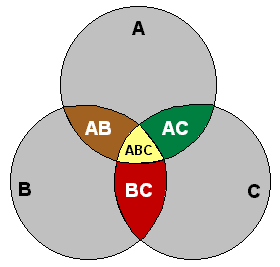
If a cause is at the intersection of multiple groups' interests, to enlist their collective action do you need to spread your efforts around the union, instead?
And what are the implications of this "union vs. intersection", "pulling together" issue, for our plethora of local groups, that don't seem to coordinate with each other? How can&should one group support/nourish others without incurring a cost to its own focus?
We seem to have silos, locally. One consequence is "playing poorly with others" behavior - a size-of-flyer arms race for limited bulletin-board space, or topic-diversions of another group's talk - when a speaker garnering a large audience comes to town, the Q&A can become a multiplicity of "could you please say a few words about why my cause is important" requests that divert from the speaker's talk.
How can our community have more cooperation, more working together on common interests, yet minimize any coercion/diversion toward interests that are much less common?
One improvement might be for each public talk to include an explicit "announcement of other talks & events" section; some groups have done this, to their credit.
If I were running the bulletin boards in town, I'd preserve the commons by granting the most favorable treatment to the smallest flyers. (And I'd tweak the local online bulletin boards to be more useful...)
And each nonprofit has a board of directors, whose job it is, to be visionaries; they should be looking out for the group's long-term mission, and considering what other groups face similar threats.
And a no-brainer: any speaker who advocates action should, if s/he thinks collective action has more power than individual action, make the effort to help the audience members they've inspired, to coalesce. To rouse your audience but then just walk away & let that energy disperse, makes your talk less effective than it could be.
We've had a couple of barnburner local "it's time to get involved" talks; they need to bear fruit.
(Preferably fruit that's not me; I would really rather see others step forward.)
Step up, please.
(Next on NCFocus: reports on Steingraber and Mach talks.)
No comments:
Post a Comment
Welcome, and thanks for caring enough to donate your time and thoughts toward greater collective wisdom...
Terms of engagement:
* Please be civil.
* * * * Please do not post anonymously * * * (I'd remove this choice if I could, and I may remove your comment if you do) - instead, do this:
Click on the 'Name/URL' radiobutton, then enter your real name (if you're brave) or a pseudonym (if you're not). (You can leave the "URL" field blank.)
Or go ahead and click "Anonymous", but put your name in your comment.
* The Management reserves the right to delete comments (Moderation Certificate can be found here). You can always post it on a blog of your own.
If you run into technical difficulties, please a) accept my apologies, then b) email your comment to aherror2011 at gmail.com with "Comment for [name of this blog]" in the Subject line.
New policy re climate contrarianism comments as of 11/11/2009:
Comments questioning the climate science community's understanding of climate change (97% of active climatologists now believe that the earth is currently warming and that it's human-caused - link) will be deleted unless the commenter:
a) is local
b) uses his real name
c) provides link(s) to substantiate his claim(s)/inference(s)
d) is willing to collaborate on constructing an argument tree, to get us past the usual sterile point-counterpoint-countercounterpoint.
(For people who can't read the above, a summary:
1) Be civil;
2) Don't post w/o giving at least a pseudonym;
3) Don't espouse climate-denial crankery unless you're local and willing to stand behind it.)
Caveats:
1. Comments could be delayed: they are being moderated, and I'm sometimes away from the computer for a day or more.
2. : Perfectly legitimate comments are sometimes miscategorized (by the blogging platform) as spam, & not published. If this happens to yours, please notify me, else I might not notice for a day or two.