Tuesday, January 20, 2009

Friday, December 05, 2008
The AP's Climate Conference Footprint Fetish
My story, published here on Gristmill yesterday.
It's odd, being edited - seeing phrasings you'd never use (most of which are improvements) appear under your name. It'd be more transparent if the editor was listed as a coauthor; now that we have the web and infinite space, why not do that, on a mouseover?
One dimension that was lost, in the post up on Gristmill, was the mouseovers; I'd composed the writing so mousing over virtually every link provided some context. Rather than consign that work to wasted effort, I've reprinted the story, as I submitted it (sans editing, plus title tags) here:
The AP's Climate Conference Footprint Fetish
Last week, CJR Observatory's Cristine Russell wrote about the Climate Change Media Partnership venture, which is enabling journalists like Brazil's Gustavo Figueiredo Faleiros to cover the Poland climate talks for their home countries.
And Michael Staples of New Brunswick's Daily Gleaner reported local high school student Taryn McKenzie-Mohr was Poland-bound, to meet and discuss climate change with other youth delegates.
And the Associated Press? Well, to judge from their stories before other climate conferences, for the AP the news isn't people like McKenzie-Mohr and Faleiros going to the climate conference, it's emissions from the flights to get them there.
Why this "small-thinking", "miss-the-forest" mindset? Where did it come from, what needs does it meet, why has it persisted? Does it naturally emerge from the reporting, or is it imposed, and by whom?
And what will looking into such episodes reveal, about AP culture?
Join me as I find out.
In the past year, three AP stories, related to two climate conferences - Bali in December 2007, and Schwarzenegger's Global Climate Summit in Los Angeles last month - have stuck out like a trio of small-thinking sore thumbs. They are Samantha Young's "Schwarzenegger summit: A sizable carbon footprint" from last month, and two stories from last December, Jakarta Bureau Chief Robin McDowell's "Climate Change Meeting Adds to Emissions" and Stockholm Bureau Chief Karl Ritter's "Climate skeptics say debate stifled" (Although the latter isn't a "conference footprint" story, it too has a "miss-the-forest" mindset.)
Young's "footprint" story from last month entailed considerable effort, including a public records request and help from three other Sacramento political reporters. But the resulting story's focus dismayed essentially everyone in it. According to Terry Tamminen, who co-wrote a rebuttal ( The measure of environmental leadership ) with CalEPA secretary Linda Adams, "The Governor's office worked with the AP writer to give her background about the entire Summit and everyone was stunned that her focus turned out to be the carbon footprint". And the three nongovernmental sources in the story - who report they weren't contacted until the day before it appeared - say the reporter was vague about its direction: "she just asked me to comment on the conference", said one; "I don't know what prompted it to take the form that it did", reported another. The strongest criticism came from Carnegie Institution climate scientist Ken Caldeira, whose views on carbon offsets had been used to bolster the story's anti-conference message. "I think this whole line of argument about how much greenhouse gas emissions come from conferences about greenhouse gas emissions reduction is pernicious", he said. "This is reminiscent of the attacks on Gore. The success of the summit is far more important than any CO2 that might be emitted traveling to or from the summit."
You might wonder, why would this story's author force it in a direction that everyone involved considers a pointless distraction from an urgent issue; particularly when, as one California climate journalist informs me, "actually, she's a very good reporter"? And how - and by whom - was the story deemed to merit the efforts of four political reporters?
I tried to find out from the AP, to no avail. The Sacramento reporter who answered my call immediately passed me to the group's overseer, who said neither he nor the others could discuss the story without prior permission from AP San Francisco Bureau Chief John Raess. Mr. Raess himself isn't talking - "As a general rule I don't comment publicly on the internal editorial process behind an individual story... [N]othing about this story...would seem to merit an exception"; and didn't grant me permission to speak with the reporters. The witnesses aren't talking, but we can still infer the Sacramento story's heritage. It appears to be modeled on AP Jakarta Bureau Chief Robin McDowell's Bali conference "footprint" story "Climate Change Meeting Adds to Emissions" (Dec. 5 2007). This story is itself a rewrite of a London Sunday Times story, "UN climate circus rolls in on CO2 cloud" (Nov. 25 2007), whose own predecessor appears to be a Sunday Times story scolding Prince Charles for his carbon footprint ("Green prince leaves a giant CO2"; June 24, 2007). These three stories all feature carbon analyses by Chris Goodall, author of "How to Live a Low-Carbon Life: The Individuals Guide to Stopping Climate Change".
A close look at the Sunday Times "Bali conference footprint" story, and then at the AP rewrite, yields interesting - perhaps meaningful, perhaps not - patterns of variation. The Sunday Times story appears inconsistent in its message: emissions from the conference, termed "a major contributor to global warming" at the outset, by the end faded to (if you do the math yourself; the article just gives the raw number) roughly 1/66,000th of the annual estimated emissions of Britain.
...the McDowell AP article closes with a weak one:
And since the AP story employs the standard AP "view from nowhere" voice in place of the British opinionated one, the judgment gets outsourced to "critics":
The third AP "small thinking" climate story is Stockholm Bureau Chief Karl Ritter's "Climate skeptics say debate stifled". Appearing the week after McDowell's "Bali footprint" piece, it gave voice to the dismay of Danish political scientist/statistician Bjorn Lomborg and other climate contrarians, at being shut out and disparaged by the climate science and climate action communities. The story made no serious attempt to determine whether past and present circumstances justify such treatment.
You might wonder why Mr. Ritter didn't address this more important issue.
And you might wonder if it's significant, that both of these stories were authored by AP Bureau Chiefs.
(According to this Daily Kos comment, the Bureau Chiefs decide which stories go out "on the wire"; so it seems more likely that a story written by a Bureau Chief would go out exactly as written, without editing or filtering - which could be a boon to public relations firms.)
I'd like to give you a clearer picture; I'd like to be able to put these questions to those who could answer them, and share with you their answers. But the AP's Director of Media Relations hasn't been willing to answer questions himself or to pass me on to others who would.
Journalist Lex Alexander of the pioneering Greensboro News and Record weighed in on this mindset back in 2005:
It's odd, being edited - seeing phrasings you'd never use (most of which are improvements) appear under your name. It'd be more transparent if the editor was listed as a coauthor; now that we have the web and infinite space, why not do that, on a mouseover?
One dimension that was lost, in the post up on Gristmill, was the mouseovers; I'd composed the writing so mousing over virtually every link provided some context. Rather than consign that work to wasted effort, I've reprinted the story, as I submitted it (sans editing, plus title tags) here:
The AP's Climate Conference Footprint Fetish
"The AP writer couldn't see the forest for the trees." - Terry Tamminen
"The fact is, we live in a glass house today, folks, and sometimes we become part of the story whether we want to be or not." - Lex AlexanderWhat a difference vision makes.
Last week, CJR Observatory's Cristine Russell wrote about the Climate Change Media Partnership venture, which is enabling journalists like Brazil's Gustavo Figueiredo Faleiros to cover the Poland climate talks for their home countries.
And Michael Staples of New Brunswick's Daily Gleaner reported local high school student Taryn McKenzie-Mohr was Poland-bound, to meet and discuss climate change with other youth delegates.
And the Associated Press? Well, to judge from their stories before other climate conferences, for the AP the news isn't people like McKenzie-Mohr and Faleiros going to the climate conference, it's emissions from the flights to get them there.
"That kind of thinking is small"..."pernicious"... "Kind of like saying the toilet didn't work well on the lunar lander in 1969 - - but, oh yes, they landed on the moon!"
And what will looking into such episodes reveal, about AP culture?
Join me as I find out.
In the past year, three AP stories, related to two climate conferences - Bali in December 2007, and Schwarzenegger's Global Climate Summit in Los Angeles last month - have stuck out like a trio of small-thinking sore thumbs. They are Samantha Young's "Schwarzenegger summit: A sizable carbon footprint" from last month, and two stories from last December, Jakarta Bureau Chief Robin McDowell's "Climate Change Meeting Adds to Emissions" and Stockholm Bureau Chief Karl Ritter's "Climate skeptics say debate stifled" (Although the latter isn't a "conference footprint" story, it too has a "miss-the-forest" mindset.)
Young's "footprint" story from last month entailed considerable effort, including a public records request and help from three other Sacramento political reporters. But the resulting story's focus dismayed essentially everyone in it. According to Terry Tamminen, who co-wrote a rebuttal ( The measure of environmental leadership ) with CalEPA secretary Linda Adams, "The Governor's office worked with the AP writer to give her background about the entire Summit and everyone was stunned that her focus turned out to be the carbon footprint". And the three nongovernmental sources in the story - who report they weren't contacted until the day before it appeared - say the reporter was vague about its direction: "she just asked me to comment on the conference", said one; "I don't know what prompted it to take the form that it did", reported another. The strongest criticism came from Carnegie Institution climate scientist Ken Caldeira, whose views on carbon offsets had been used to bolster the story's anti-conference message. "I think this whole line of argument about how much greenhouse gas emissions come from conferences about greenhouse gas emissions reduction is pernicious", he said. "This is reminiscent of the attacks on Gore. The success of the summit is far more important than any CO2 that might be emitted traveling to or from the summit."
You might wonder, why would this story's author force it in a direction that everyone involved considers a pointless distraction from an urgent issue; particularly when, as one California climate journalist informs me, "actually, she's a very good reporter"? And how - and by whom - was the story deemed to merit the efforts of four political reporters?
I tried to find out from the AP, to no avail. The Sacramento reporter who answered my call immediately passed me to the group's overseer, who said neither he nor the others could discuss the story without prior permission from AP San Francisco Bureau Chief John Raess. Mr. Raess himself isn't talking - "As a general rule I don't comment publicly on the internal editorial process behind an individual story... [N]othing about this story...would seem to merit an exception"; and didn't grant me permission to speak with the reporters. The witnesses aren't talking, but we can still infer the Sacramento story's heritage. It appears to be modeled on AP Jakarta Bureau Chief Robin McDowell's Bali conference "footprint" story "Climate Change Meeting Adds to Emissions" (Dec. 5 2007). This story is itself a rewrite of a London Sunday Times story, "UN climate circus rolls in on CO2 cloud" (Nov. 25 2007), whose own predecessor appears to be a Sunday Times story scolding Prince Charles for his carbon footprint ("Green prince leaves a giant CO2"; June 24, 2007). These three stories all feature carbon analyses by Chris Goodall, author of "How to Live a Low-Carbon Life: The Individuals Guide to Stopping Climate Change".
A close look at the Sunday Times "Bali conference footprint" story, and then at the AP rewrite, yields interesting - perhaps meaningful, perhaps not - patterns of variation. The Sunday Times story appears inconsistent in its message: emissions from the conference, termed "a major contributor to global warming" at the outset, by the end faded to (if you do the math yourself; the article just gives the raw number) roughly 1/66,000th of the annual estimated emissions of Britain.
The subsequent AP rewrite has a more consistent "anti-conference" message, which it achieves by diminishing content that would call this message into question: the comparison with Britain's annual emissions for context is gone, and the story's final, key quote is much weaker. Where the Sunday Times story had closed with a strong justification for the conference:("The emissions from Bali, although huge for such an event, remain small on a global scale. Britain, for example, emits the equivalent of 660m tonnes of CO2 a year.")
"Achim Steiner, director of the UN Environment Programme, said such conferences could never be small. "If you want to tackle an unprecedented global challenge like climate change then people have to meet and talk. Bali remains the world's best hope to minimise the effect of global warming." "
...the McDowell AP article closes with a weak one:
"It may sound like a lot of people, [b]ut you have to look at the issues, the number of countries involved, the number of people affected. Global warming is literally everyone's business."
"But critics say [the conference-goers] are contributing to the very problem they aim to solve".
These critics turn out to be one Chris Goodall, the gentleman commissioned to perform the original story's carbon analysis.
You might wonder why Ms. McDowell chose to adopt the Sunday Times's "small thinking" meme, and reshape the story to increase its outrage factor.The third AP "small thinking" climate story is Stockholm Bureau Chief Karl Ritter's "Climate skeptics say debate stifled". Appearing the week after McDowell's "Bali footprint" piece, it gave voice to the dismay of Danish political scientist/statistician Bjorn Lomborg and other climate contrarians, at being shut out and disparaged by the climate science and climate action communities. The story made no serious attempt to determine whether past and present circumstances justify such treatment.
You might wonder why Mr. Ritter didn't address this more important issue.
(According to this Daily Kos comment, the Bureau Chiefs decide which stories go out "on the wire"; so it seems more likely that a story written by a Bureau Chief would go out exactly as written, without editing or filtering - which could be a boon to public relations firms.)
I'd like to give you a clearer picture; I'd like to be able to put these questions to those who could answer them, and share with you their answers. But the AP's Director of Media Relations hasn't been willing to answer questions himself or to pass me on to others who would.
Journalist Lex Alexander of the pioneering Greensboro News and Record weighed in on this mindset back in 2005:
"The fact is, we live in a glass house today, folks, and sometimes we become part of the story whether we want to be or not.And we've got three ways we can respond. We can get all defensive and arrogant. We can take the kind of absolutely silent approach that comes across as defensive and arrogant. Or we can acknowledge in fact what we always say whenever we're pushing for more liberal open-records laws: We're a public trust. We work for the people. And if we're smart, we're going to work _with_ the people as well, and talk to the people about how we can best do that."
He's right.
Open-Source Journalism: It's a Lot Tougher Than You Think
I never did get around to linking to my Assignment Zero article from last year, that appeared on Wired - here it is.
Thursday, December 04, 2008
Two excellent climate posts from Tobis and Romm
From last spring, Joe Romm's PLEASE stop calling them “skeptics”
And from last summer, Michael Tobis's Science, Impartial Honesty, Advocacy, Stridency, Idiocy, Dissembling, Lying Through Your Teeth
"I suspect future generations will call them “climate destroyers” or worse — since if we actually (continue to) listen to them, that pretty much ensures carbon dioxide concentrations will hit catastrophic levels, 700 to 1000, this century, as explained in Part II. But what should we call these people in the meantime, while we still have time to ignore them and save the climate?"
And from last summer, Michael Tobis's Science, Impartial Honesty, Advocacy, Stridency, Idiocy, Dissembling, Lying Through Your Teeth
"If you attack an opinion that is merely misguided as if it were malicious, you come off as arrogant, while if you try to cope with an opinion that is malicious as if it were misguided, you can fall prey to all sorts of polemical gamesmanship."...with an interesting comment speculating about the delayers' strategies.
Friday, November 21, 2008
Resources for the perplexed, on global warming
(this is primarily for Nevada County residents)
Updates are in italics.
So, you listened to Robert C. Balling Jr. (a speaker recommended by what Real Climate calls "the notorious "Heartland Institute" that we have commented on previously") on KVMR Tuesday night, he sounded reasonable, and you're confused.
Who can you trust? Is he right, that the only trustworthy way to know the state of the science on climate change is to read the IPCC report?
um, no.
Sure, you can, but that's not how we acquire our (public) understanding of science in other areas, and it doesn't have to be how you do it here either. You're certainly welcome to delve into the science, the back-and-forth on evidence for this assertion and that (and I can suggest some sites to help you in doing so, e.g. Skeptical Science), but the highest return-on-investment, if you've got 5 minutes for learning about this topic, is (in my opinion) to pick the right "network of trust".
Free-market (anti-regulation) ideologues backed by coal interests, such as the Heartland Institute (for which Dr. Balling is a speaker) aren't going to give you an unbiased view of climate science. They're the national equivalent of CABPRO.
So who can you trust?
The issue is, what does the science tell us? And the best, cleanest, most untainted fastest way for you to find this out, is to go to the websites of prestigious science institutions, and see what *they* tell us. Fortunately, most of them do now have sections on their website devoted to climate change.
The Royal Society of London has been publishing for 150 years; their section on climate change is here.
Nature is the top ranking science journal; their section on climate change is here.
Scientific American has been publishing science for nonscientists, for decades; here's one article about climate from them (no general intro on their site, that I could see)
Science News has also been publishing science for nonscientists, for decades; their section on climate change is here (alas, it's not a general intro, it looks to be just a list of their latest climate-related articles).
UCSD Provost and historian of science Naomi Oreskes did a classic study of the climate science literature, finding a consensus - see this post about it from the climatologists' blog RealClimate.
(if you want climate science from the horses' mouths, RealClimate is the place to go - these guys are the real thing.)
And if you want to grasp the science for yourself, try her
The Scientific Consensus on Climate Change: How Do We Know We're Not Wrong? (PDF)
And - in case you're wondering why the public has been confused about the state of climate change science for the last 20 years - there has been a concerted effort, by the fossil fuel interests, to cloud this issue and manufacture doubt in your own mind, since doubt is paralyzing and delaying action is their goal. See Ross Gelbspan's Snowed and Mooney's Some Like It Hot; Sharon Begley in Newsweek has also covered this (The Truth About Denial), also other magazines.
(A book that'll open your eyes, btw, is Doubt is their Product, by David Michaels, documenting the "product defense industry" - where there's money to be made in delaying new regulations, there's a company-for-hire working to achieve that goal)
And keep your eyes open - if all goes well, NCTV will soon be airing a talk by Dr. Oreskes about the disinformation effort.
Climatologist Jim Hansen - who saw this coming 20 years ago, and has perhaps the best track record of anyone - has said that the most important lifestyle change you can make to fight global warming is to become politically active (on this issue) and hold the politicians accountable.
So - please consider that, whenever you put out your recycling.
and, in general, on all sorts of issues you can do surprisingly well at grasping the reality, *without* looking at the underlying data; you can make intelligent judgments based on higher-level factors. One of the best things I've ever read online is Daniel Davies' One Minute MBA - Avoiding Projects Pursued By Morons 101 ("business schools...do often feel like the most collossal waste of time and money, but they occasionally teach you the odd thing which is very useful indeed...")
you might also google
wonderingmind42 video
and see what Greg Craven has to say, about what we should choose to do. He's entertaining, he's humble, and he's clear.
(he's a high school science teacher)
And if you want to keep aware of climate news etc, there's warming101.com, my blog aggregator for reputable commentary about climate change.
Another resource - Scienceblogs.com - is a nexus for intelligent science commentary by scientists.
Logicalscience.com is good site for more information, including lists of professional scientific organizations (i.e., not "think tanks", which are really PR shops) that have issued "consensus" statements about climate change, and the statements they've issued.
Hope this helps. If you have questions, feel free to leave a comment, or else stop by and talk sometime - I'm in Java John's on Broad St, many mornings, and would love to discuss this.
Does it matter? Yes, it does -
Updates are in italics.
So, you listened to Robert C. Balling Jr. (a speaker recommended by what Real Climate calls "the notorious "Heartland Institute" that we have commented on previously") on KVMR Tuesday night, he sounded reasonable, and you're confused.
Who can you trust? Is he right, that the only trustworthy way to know the state of the science on climate change is to read the IPCC report?
um, no.
Sure, you can, but that's not how we acquire our (public) understanding of science in other areas, and it doesn't have to be how you do it here either. You're certainly welcome to delve into the science, the back-and-forth on evidence for this assertion and that (and I can suggest some sites to help you in doing so, e.g. Skeptical Science), but the highest return-on-investment, if you've got 5 minutes for learning about this topic, is (in my opinion) to pick the right "network of trust".
Free-market (anti-regulation) ideologues backed by coal interests, such as the Heartland Institute (for which Dr. Balling is a speaker) aren't going to give you an unbiased view of climate science. They're the national equivalent of CABPRO.
So who can you trust?
The issue is, what does the science tell us? And the best, cleanest, most untainted fastest way for you to find this out, is to go to the websites of prestigious science institutions, and see what *they* tell us. Fortunately, most of them do now have sections on their website devoted to climate change.
The Royal Society of London has been publishing for 150 years; their section on climate change is here.
Nature is the top ranking science journal; their section on climate change is here.
Scientific American has been publishing science for nonscientists, for decades; here's one article about climate from them (no general intro on their site, that I could see)
Science News has also been publishing science for nonscientists, for decades; their section on climate change is here (alas, it's not a general intro, it looks to be just a list of their latest climate-related articles).
UCSD Provost and historian of science Naomi Oreskes did a classic study of the climate science literature, finding a consensus - see this post about it from the climatologists' blog RealClimate.
(if you want climate science from the horses' mouths, RealClimate is the place to go - these guys are the real thing.)
And if you want to grasp the science for yourself, try her
The Scientific Consensus on Climate Change: How Do We Know We're Not Wrong? (PDF)
And - in case you're wondering why the public has been confused about the state of climate change science for the last 20 years - there has been a concerted effort, by the fossil fuel interests, to cloud this issue and manufacture doubt in your own mind, since doubt is paralyzing and delaying action is their goal. See Ross Gelbspan's Snowed and Mooney's Some Like It Hot; Sharon Begley in Newsweek has also covered this (The Truth About Denial), also other magazines.
(A book that'll open your eyes, btw, is Doubt is their Product, by David Michaels, documenting the "product defense industry" - where there's money to be made in delaying new regulations, there's a company-for-hire working to achieve that goal)
And keep your eyes open - if all goes well, NCTV will soon be airing a talk by Dr. Oreskes about the disinformation effort.
Climatologist Jim Hansen - who saw this coming 20 years ago, and has perhaps the best track record of anyone - has said that the most important lifestyle change you can make to fight global warming is to become politically active (on this issue) and hold the politicians accountable.
So - please consider that, whenever you put out your recycling.
and, in general, on all sorts of issues you can do surprisingly well at grasping the reality, *without* looking at the underlying data; you can make intelligent judgments based on higher-level factors. One of the best things I've ever read online is Daniel Davies' One Minute MBA - Avoiding Projects Pursued By Morons 101 ("business schools...do often feel like the most collossal waste of time and money, but they occasionally teach you the odd thing which is very useful indeed...")
you might also google
wonderingmind42 video
and see what Greg Craven has to say, about what we should choose to do. He's entertaining, he's humble, and he's clear.
(he's a high school science teacher)
And if you want to keep aware of climate news etc, there's warming101.com, my blog aggregator for reputable commentary about climate change.
Another resource - Scienceblogs.com - is a nexus for intelligent science commentary by scientists.
Logicalscience.com is good site for more information, including lists of professional scientific organizations (i.e., not "think tanks", which are really PR shops) that have issued "consensus" statements about climate change, and the statements they've issued.
Hope this helps. If you have questions, feel free to leave a comment, or else stop by and talk sometime - I'm in Java John's on Broad St, many mornings, and would love to discuss this.
Does it matter? Yes, it does -
"Climate scientists who grapple with this every day ... we see where it's headed. We understand it very well.
"I think the public needs to know, straight in their face, that you can give up on civilization as we know it. This is what I'm trying to get across in the book. Do we actually give a s--- for future generations?"
"I think the public needs to know, straight in their face, that you can give up on civilization as we know it. This is what I'm trying to get across in the book. Do we actually give a s--- for future generations?"
Thursday, November 20, 2008
Q for climate bloggers - why *not* give Heartland spokesmen airtime?
Our local community radio station featured Robert C. Balling Jr. as a guest Tuesday night, for a call-in. I had a very interesting talk with their news director about it yesterday, that I'm still chewing on.
But I'm wondering, ye with collective wisdom -
How would you explain, pithily, to someone who values free expression of divergent views, wants his listeners to be exposed to a variety of views and to chew on the ideas and evidence for themselves, and knows that the climate science, on what the future effects will be, is *not* monolithic -
... that bringing a Heartland speaker on to discuss global warming science - a climate scientist who's published in peer reviewed journals, who says he's not a denialist, he just has different views on how strong an effect increasing CO2 will have - doesn't serve the station's listeners?
For the purpose of this exercise, assume your word carries as much weight as Joe Blow's down the street.
Note: Please comment *only* if you share the mainstream view that climate change is happening, the evidence strongly indicates humans are causing it, and it's urgent that we address it now - comments from the fringe *will* be deleted.
also - where can I find the "ontogeny of climate inactivism" scale? It's basically this, right?:
1. It's not happening
2. It's might be happening, but it's not us
3. It's happening, it's us, but it won't be too bad
4. It's happening, it's us, it'll be bad, but it'll be cheaper to leave it for our children to fix
5. Nothing we can do about it, since here comes China
But I'm wondering, ye with collective wisdom -
How would you explain, pithily, to someone who values free expression of divergent views, wants his listeners to be exposed to a variety of views and to chew on the ideas and evidence for themselves, and knows that the climate science, on what the future effects will be, is *not* monolithic -
... that bringing a Heartland speaker on to discuss global warming science - a climate scientist who's published in peer reviewed journals, who says he's not a denialist, he just has different views on how strong an effect increasing CO2 will have - doesn't serve the station's listeners?
For the purpose of this exercise, assume your word carries as much weight as Joe Blow's down the street.
Note: Please comment *only* if you share the mainstream view that climate change is happening, the evidence strongly indicates humans are causing it, and it's urgent that we address it now - comments from the fringe *will* be deleted.
also - where can I find the "ontogeny of climate inactivism" scale? It's basically this, right?:
1. It's not happening
2. It's might be happening, but it's not us
3. It's happening, it's us, but it won't be too bad
4. It's happening, it's us, it'll be bad, but it'll be cheaper to leave it for our children to fix
5. Nothing we can do about it, since here comes China
Wednesday, November 19, 2008
Robert C. Balling Jr, the day after
Dec 10 update: partial response from Dr. Balling (he says he wasn't paid to do the KVMR call-in) below.
----------
You know how you always realize afterwards, what you should have said?
Fortunately in this day&age we have email; so I've sent this to Dr. Balling:
--------------
Dec.10 update - I hadn't received a response, so yesterday I sent this:
----------
You know how you always realize afterwards, what you should have said?
Fortunately in this day&age we have email; so I've sent this to Dr. Balling:
Subject: A couple of leftover Qs from KVMR Q&A last night
Hello again Dr. Balling, and my apologies for not having been more prepared, last night. Not only did I waste your time and KVMR's, I probably sounded like an idiot... sorry.
Could you give me a rough estimate, please, of your yearly income from sources other than your university salary? - i.e. from Heartland, the Greening Earth Society, other such organizations, speaking engagements, etc?
And who pays you to do public outreach such as last night's KVMR call-in?
Thanks much -
Anna Haynes PhD
ncfocus.blogspot.com
Hello again Dr. Balling, and my apologies for not having been more prepared, last night. Not only did I waste your time and KVMR's, I probably sounded like an idiot... sorry.
Could you give me a rough estimate, please, of your yearly income from sources other than your university salary? - i.e. from Heartland, the Greening Earth Society, other such organizations, speaking engagements, etc?
And who pays you to do public outreach such as last night's KVMR call-in?
Thanks much -
Anna Haynes PhD
ncfocus.blogspot.com
--------------
Dec.10 update - I hadn't received a response, so yesterday I sent this:
Hello again Dr. Balling, I'm not sure my first email reached you.
Could you tell me please, who pays you, and how much, to do a radio call-in appearance like the one you did for KVMR last month?
Thanks very much -
Anna Haynes
He responded Could you tell me please, who pays you, and how much, to do a radio call-in appearance like the one you did for KVMR last month?
Thanks very much -
Anna Haynes
That's easy -- $0.00. I have done many radio appearances over the years, and my total is still $0.00. I have done TV appearances, and the total is $0.00.
Tuesday, November 18, 2008
KVMR News with Robert Balling Jr tonight
For anyone who listened, my apologies - I'd only been told that there'd be "a call-in on climate change"; I didn't know - until 5 seconds before he started speaking - that it'd be with Robert Balling.
I should have asked; I would have been better prepared.
Update: M3U of the discussion, from KVMR news page; i don't think it's a permalink, so grab it soon.
A bit of googling shows that Robert Balling was involved with ICE - the "Information Council on the Environment":
ICE is featured in the Naomi Oreskes talk on the Western Fuels Association, in which she concludes:
'nuff said.
I should have asked; I would have been better prepared.
Update: M3U of the discussion, from KVMR news page; i don't think it's a permalink, so grab it soon.
A bit of googling shows that Robert Balling was involved with ICE - the "Information Council on the Environment":
The Information Council on the Environment (ICE), was a U.S. organization created by the National Coal Association, the Western Fuels Association, and Edison Electrical Institute. ICE launched a $500,000 advertising and public relations campaign to, in ICE's words, "reposition global warming as theory (not fact)." Patrick Michaels, Robert Balling and Sherwood B. Idso all lent their names in 1991 to its scientific advisory panel.
Its publicity plan called for placing these three scientists, along with fellow greenhouse skeptic S. Fred Singer, in broadcast appearances, op-ed pages, and newspaper interviews. ...
ICE is featured in the Naomi Oreskes talk on the Western Fuels Association, in which she concludes:
"...[Polls show that] while most Americans now do accept global warming as a fact, they don't accept its origins in scientific consensus; they think that scientists are still arguing about it, and this may have played some role in the reluctance of our leaders to actually do something about it.
And it suggests that the resistance campaigns were effective in creating a lasting impression of scientific disagreement, discord, and dissent."
'nuff said.
News values of the Associated Press
"We abhor inaccuracies, carelessness, bias or distortions
We always strive to identify all the sources of our information...
We avoid behavior or activities that create a conflict of interest and compromise our ability to report the news fairly and accurately, uninfluenced by any person or action.
[I]t is the responsibility of every one of us to ensure that these standards are upheld.
Any time a question is raised about any aspect of our work, it should be taken seriously.
Transparency is critical to our credibility..."
We always strive to identify all the sources of our information...
We avoid behavior or activities that create a conflict of interest and compromise our ability to report the news fairly and accurately, uninfluenced by any person or action.
[I]t is the responsibility of every one of us to ensure that these standards are upheld.
Any time a question is raised about any aspect of our work, it should be taken seriously.
Transparency is critical to our credibility..."
- from the AP News Values page
Related - "1919: Upton Sinclair includes a scathing criticism of the AP in his investigative book on contemporary journalism, The Brass Check."
Monday, November 17, 2008
Conundrum
Related.
Suppose you know someone who engages in boorish behavior; what kind of feedback can you give such a person, that'd be most likely to help them to recognize it, to see how others perceive it, and to stop it?
Particularly if they're wired to interpret criticism as insult.
Constructive answers only, with sample dialogue, please.
(if you make any other comments, save a copy, because it may get deleted.)
Bonus Q: how, as a society, can we most constructively integrate people who are "high dudgeon" addicts?
Suppose you know someone who engages in boorish behavior; what kind of feedback can you give such a person, that'd be most likely to help them to recognize it, to see how others perceive it, and to stop it?
Particularly if they're wired to interpret criticism as insult.
Constructive answers only, with sample dialogue, please.
(if you make any other comments, save a copy, because it may get deleted.)
Bonus Q: how, as a society, can we most constructively integrate people who are "high dudgeon" addicts?
Sunday, November 16, 2008
Knock knock: In Nevada County, it ain't the Avon Lady
... more like the ovine lady, or a portion thereof.
(this isn't news anymore, being 2 weeks old, but - particularly for city-folk who don't have a feel for our local culture - I did want to document it. Beware: photo below.)
News sources report that on the night of Oct 30, a severed sheep's head showed up on the doorstep of CA District 4 Democratic candidate Charlie Brown's campaign headquarters in Grass Valley.
Police were, of course, investigating.
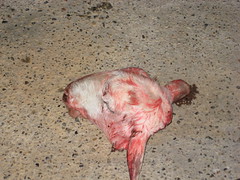
Photo from Calitics (where it's a goat), story from The Union (where it's a sheep).
(And in other news, we have a new President-Elect. Good news: this one comes with a brain that isn't still shrink-wrapped - and is still attached.)
(this isn't news anymore, being 2 weeks old, but - particularly for city-folk who don't have a feel for our local culture - I did want to document it. Beware: photo below.)
News sources report that on the night of Oct 30, a severed sheep's head showed up on the doorstep of CA District 4 Democratic candidate Charlie Brown's campaign headquarters in Grass Valley.
Police were, of course, investigating.
Photo from Calitics (where it's a goat), story from The Union (where it's a sheep).
(And in other news, we have a new President-Elect. Good news: this one comes with a brain that isn't still shrink-wrapped - and is still attached.)
Friday, November 14, 2008
Jeff Pelline responds to Messenger story
Updated Nov 17; Nuke Brunswick responds in comments
Jeff Pelline's response, which I'd requested earlier today regarding the Mountain Messenger story:
Jeff Pelline's response, which I'd requested earlier today regarding the Mountain Messenger story:
I’m flattered this paper choose to write about me, but the fact that this paper wouldn’t contact me for a story about me says everything I need to know about The Mountain Messenger and this report’s credibility.
[Reporter's response here in comments - Ed.]
If I were going to write a story about the Editor of The Mountain Messenger, I would contact him or her directly. I received no messages from the paper: the first I heard of it was from blogger Anna Haynes. Also, who is reporter “Nuke Brunswick?” The name doesn’t appear on the list of staff members. When our reporter writes a story, we put our real names and contact information at the end of the story.
I also can state that the story is full of inaccuracies. If someone had called, I would have pointed out:
•Here’s the story about the Fire Safe Council that ran on The Union’s Web site about an hour after our meeting with them.
The article ran in the paper the next day as well — on the front page. So we didn’t “refuse to publish anything.” We published two stories: one on the Web and one in print.
The reason we had to abruptly end the Fire Safe Council meeting was to post the story on our Web site to match the press release that had been handed to our news competitors prior to our meeting. We were the first to inquire about this story, based on a tip we got, but the last to get the information. We compete in real time with a radio station, not on daily print newspaper cycle. Since this incident, we have run other stories about the Fire Safe Council’s efforts.
I also worry about being treated fairly by some local groups whose board members also happen to be owners of the competing radio station or other news outlets — something we encounter from time to time. For example, the Fire Safe Council also has board members who are owners of our competitors. I was assured this relationship — and potential conflict of interest — has no bearing on the timing of how news gets disseminated.
•As for the event at Miners Foundry, it was pitched as a communitywide, all inclusive media event. The Union, however, wasn’t invited. When we learned this, we met with the Miners Foundry and said we’d like to join as sponsors. They were happy to have us. We volunteered to help set up audio and video equipment, and donate $200 for food. We decided to back out of the event a day later after reading on the Democratic Party Web site that people of “like minds” were being invited to this so-called nonpartisan event. As it turned out, the GOP was holding an election party at Tailgaters. We wouldn’t sponsor that event either, for the same reasons. The “code of ethics” in our newsroom states we cannot sponsor partisan political events. I thought most news organizations, including the ones here, had such a policy.
As for the coverage of the Miners Foundry event (as distinct to sponsorship), we published a story in the paper promoting the party, and we published a large photo of the Miners Foundry party on the front page of the paper the day after the election showing the party-goers. I venture to say we gave it more publicity than anybody. We also received a thank you note from the Miners Foundry for covering the event. They also apologized for the misunderstanding. We also discussed some future coverage of Miners Foundry events. You’ll be reading plenty of news about the Miners Foundry, the Fire Safe Council and other groups in the future.
I hope this helps clarify matters. I suppose we’re obliged to show the article to a lawyer for a second opinion, but for now, we’ll just drop the matter. I’m surprised The Mountain Messenger would run an article like this.
Walled gardens with a vengeance? Jeff Pelline covered in Mountain Messenger article
Update: or not; Jeff P. responds (and Yubanet puts the Mountain Messenger story online)
Seems like it was only yesterday that I was praising The Union editor Jeff Pelline for breaching the paper's walled garden, by enabling RSS feeds for their on-site weblogs. But another day, another revision of the story (or not; see Jeff P.'s response): the Mountain Messenger reports that elsewhere in the garden, the walls have grown massive, heavily fortified, and topped with broken glass.
I emailed Jeff Pelline asking for his response, since it doesn't appear that he was contacted for the story. (his response is here)
I'm trying to get the Mountain Messenger to start a blog, so they can put their Nevada County stories online.
(Some other Messenger articles (ballot, tourists, business) have appeared on Yubanet, but not this one, as of this writing.)
Related:
the inflammatory Haute Trash and Stuckey editor-vs.-public email exchanges from pre-Pelline years;
March 2007 'arrogance and censorship' NCFocus post;
my suggestion from back near the start of the Messenger-vs-Union conflict: "It seems to me the Mountain Messenger ought to...(un)cover Nevada County. Then The Union could retaliate... and it could escalate from there, and the 2 counties would benefit enormously...newspaper sales would skyrocket."
Fear and Loathing in a One Newspaper Community?
NevadaCo Wrestles with Media Monopoly
Seems like it was only yesterday that I was praising The Union editor Jeff Pelline for breaching the paper's walled garden, by enabling RSS feeds for their on-site weblogs. But another day, another revision of the story (or not; see Jeff P.'s response): the Mountain Messenger reports that elsewhere in the garden, the walls have grown massive, heavily fortified, and topped with broken glass.
"Intimidation and retaliation tactics have long been seen as one of the paper's, and Pelline's, main ways of dealing with dissent in the community. ... waging a vendetta against radio station KNCO ... '[Pelline] wanted an exclusive story and when we told him that we had given it to KNCO as well, he said "The meeting is over" and he left the room'..."
"...not a further drop of ink about the Foundry would appear in print if the paper was not allowed to participate..."
I emailed Jeff Pelline asking for his response, since it doesn't appear that he was contacted for the story. (his response is here)
I'm trying to get the Mountain Messenger to start a blog, so they can put their Nevada County stories online.
(Some other Messenger articles (ballot, tourists, business) have appeared on Yubanet, but not this one, as of this writing.)
Related:
the inflammatory Haute Trash and Stuckey editor-vs.-public email exchanges from pre-Pelline years;
March 2007 'arrogance and censorship' NCFocus post;
my suggestion from back near the start of the Messenger-vs-Union conflict: "It seems to me the Mountain Messenger ought to...(un)cover Nevada County. Then The Union could retaliate... and it could escalate from there, and the 2 counties would benefit enormously...newspaper sales would skyrocket."
Introducing the Comment Purgatory
(Update & bug report: as displayed on NCVoices, the Purgatory's comment permalinks don't go where they should, and I don't have time to fix it now. Workaround: go to the sidebar of the Purgatory's home page (or here), and click on the comment from there.)
I don't know if there's a demand for this, and I do know I shouldn't have taken the time to create it, but - the Nevada County Comment Purgatory is now open for business. It sits over in the far right column of Nevada County Voices, and is a place for you to put your civil comments that got rejected locally.
It's an experiment.
I don't know if there's a demand for this, and I do know I shouldn't have taken the time to create it, but - the Nevada County Comment Purgatory is now open for business. It sits over in the far right column of Nevada County Voices, and is a place for you to put your civil comments that got rejected locally.
It's an experiment.
Thursday, November 13, 2008
The Union's blogs - soon on NCVoices
Next-day update: this isn't the whole story
It turns out The Union's blogs now have RSS feeds, which is excellent news (if not exactly new; when did they get them?). Kudos to Jeff Pelline for opening up the walled garden.
(and auxiliary kudos for recently taking Russ Steele to task for using his official position on the ERC as a soapbox for flat-earth preaching)
I'll be adding these blogs to Nevada County Voices soon.
(originally mistyped "Nevada County Vices", which frames our home turf in a different way...)
It turns out The Union's blogs now have RSS feeds, which is excellent news (if not exactly new; when did they get them?). Kudos to Jeff Pelline for opening up the walled garden.
(and auxiliary kudos for recently taking Russ Steele to task for using his official position on the ERC as a soapbox for flat-earth preaching)
I'll be adding these blogs to Nevada County Voices soon.
(originally mistyped "Nevada County Vices", which frames our home turf in a different way...)
Subscribe to:
Posts (Atom)